The Victorians out-spent us. That is not the comfort it sounds like.
Everyone is arguing about whether AI is a bubble. That is a question about money, and money is the one part of this that history has already seen bigger.
How deep do you want to go? Pick a level and the article rewrites itself.
There is a particular sort of person who, caught in a downpour, will tell you with total confidence that this is the wettest it has ever been. They have no data. They are simply wet.
We are all that person about artificial intelligence at the moment, and I include myself. Every conversation I have had this year has contained some version of “nothing like this has ever happened before”, usually delivered by someone who has just watched a chatbot write a birthday poem.
So I went and checked. I scaled this thing against the biggest things humans have ever done: the railways, the moon, the bomb, the invention of writing itself. And the results are not what the headlines would have you expect.
On money, we are losing. Badly.
We are having the wrong argument
Open any newspaper and you will find the same debate: is AI a bubble, or is it not? Trillions of dollars, data centres the size of towns, share prices that make no sense. Boom or bust. Pick a side.
It is a perfectly reasonable question. It is also a question about money, and money turns out to be the least remarkable thing about this whole affair. If you want to know what is genuinely unprecedented here, you have to stop looking at the cheque and start looking at the clock.
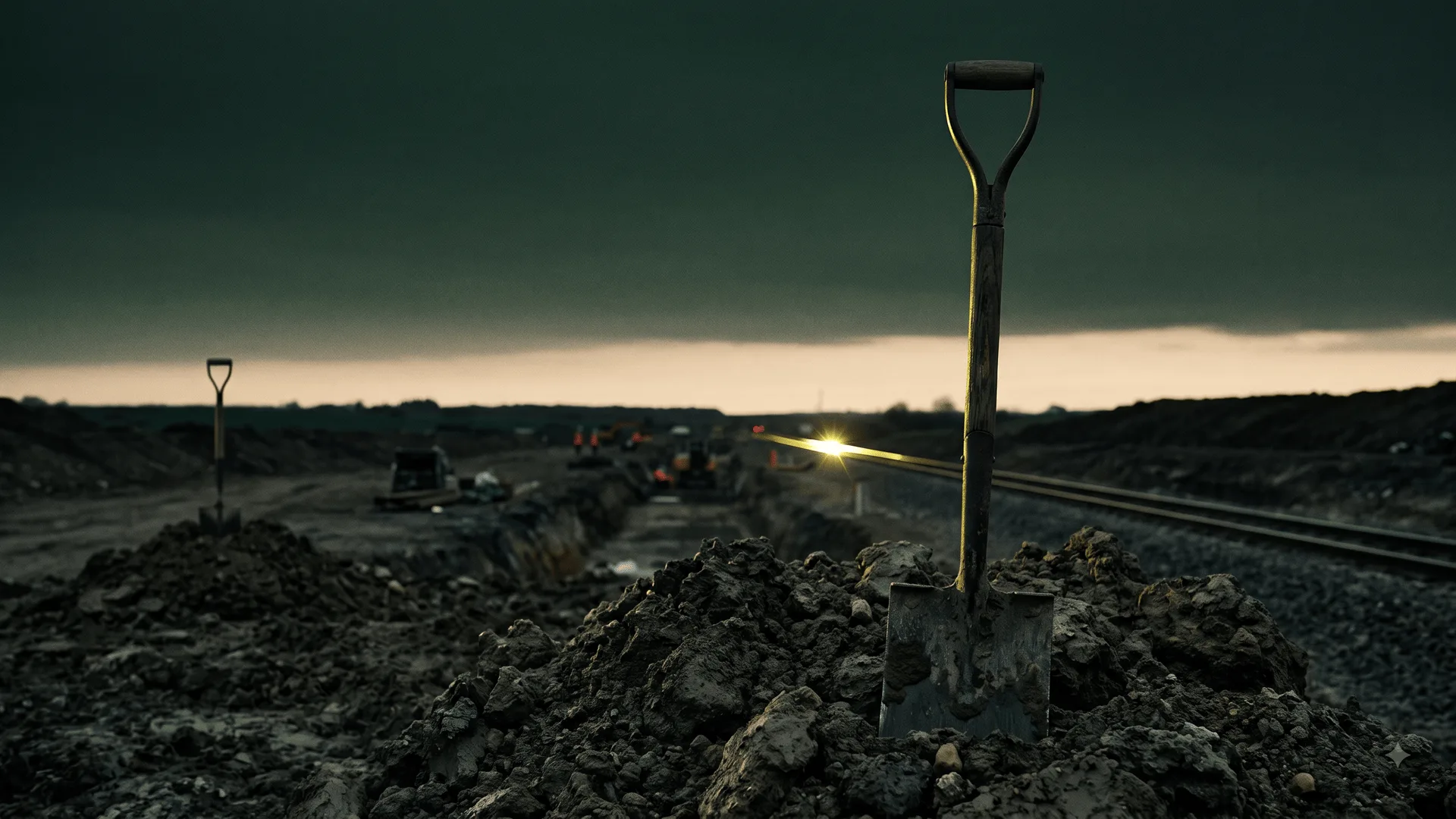
Beaten by men with shovels
Here is the number everybody quotes. In 2024, AI infrastructure spending hit roughly $500 billion, which is about 1.6% of US GDP. Vast. Genuinely vast. It is more, as a share of the economy, than the Manhattan Project at its 1945 peak (0.9%) and more than the Apollo programme at its 1966 peak (0.7%). We are currently spending more on making computers talk than America spent on getting to the moon.
Now here is the number nobody quotes.
| What | When | Share of GDP |
|---|---|---|
| US railroads | 1870 | 6.0% |
| AI buildout (projected) | 2027 | 3.1% |
| AI buildout | 2024 | 1.6% |
| Telecoms and fibre | 2000 | 1.2% |
| Manhattan Project | 1945 | 0.9% |
| Apollo programme | 1966 | 0.7% |
Six percent. In 1870, Americans were pouring six percent of everything they earned into laying iron track across a continent, and they were doing it with picks, horses, black powder and a standard of workplace safety best described as optimistic. No electricity. No computers. No spreadsheets. Just an enormous number of very tired men and a national conviction that the future ran on rails.
Our unprecedented, world-historic, trillion-dollar AI boom is currently running at about a quarter of that. Torsten Slok at Apollo Global Management reckons it climbs to 3.1% of GDP by 2027, which would be triple the 1990s telecoms boom and roughly twice as fast a build as the mid-2000s housing bubble. Still barely half a railway mania.
The Victorians committed six percent of their economy to a technology bet, using shovels. We are at 1.6, and we think we are being brave.
And before anyone finds that reassuring, remember how the railway story ends. It was a proper bubble: giddy newspapers, novice investors, a national narrative about a new era, and then a crash that flattened fortunes and left early backers with nothing. What it also left was the track. The rails stayed in the ground and quietly rewired commerce, time zones and the shape of every town in Britain for the next century.
The dot-com fibre boom did the same. Telecoms companies spent 1.2% of GDP burying cable on the assumption that internet traffic would double every hundred days. It did not, they went bust, and the “dark fibre” they left behind became the cheap pipe that Netflix and the smartphone ran on ten years later.
So if you are hoping the AI bubble bursting will make the data centres go away: it will not. Bubbles do not remove infrastructure. They just change who owns it, usually at a considerable discount.
So what did actually break the record?
The clock. Every single record AI has broken is a record about speed, not size.
ChatGPT reached 100 million users in about two months, the fastest consumer adoption ever measured. It hit 10% weekly adoption in the United States in under two years, and 30% roughly six months after that. Sensible extrapolation from historical technology curves, done in 2022, suggested a technology this complicated should need around eight years just to reach that first 10%.
Set that against the comparison class. Electricity needed about forty years to reach seven in ten American homes. The telephone took about sixty. Both of those, incidentally, were considered indecently fast at the time.
This is the actual anomaly, and it is a strange one, because nothing about it is technological. The capability arrived quickly, yes. But the reason it spread quickly is that it needed no track, no cable, no meter, no engineer, no rewiring of your house. It arrived down a pipe that was already there, and it spoke English.
Three thousand years to agree on an alphabet
If you want the properly humbling comparison, though, forget the railways. Go back further, to the last time humanity handed a piece of its own mind to an external tool.
Around 1200 BCE, under China's Shang dynasty, somebody scratched marks into a turtle shell. These are the oracle bones, and they are the earliest recognisable Chinese characters we have. They were not used for administration or letters or accounts. They were used to ask dead relatives whether it was a good week to go to war.
It then took the best part of a thousand years for that to become a working technology of state. Not until 221 BCE, when the first Qin emperor standardised the script to hold a fractured empire together, did writing turn from a priestly ritual into the operating system of government. A millennium, roughly, from prototype to platform.
And here is the part that I cannot stop thinking about. For nearly all of human existence, the tools you were handed as a child were the tools you handed on as an old man. A person born into the Bronze Age died in the Bronze Age. Change happened, but it happened to your great-grandchildren, somewhere over the horizon, and you never saw it. Progress was a rumour.
Every technology before this one gave us a generation to think about it. This one gave us a Christmas.
Writing externalised human memory. That was the deal: your knowledge could now outlive your skull. Every tool since, from the abacus to the filing cabinet to Google, has been a variation on that same bargain. Storage and retrieval, handed outwards. The thinking stayed in the head, where it had always been.
What changed in late 2022 is that we started handing out the thinking too. That is what makes this different from the steam engine, and it is not a small difference. A steam engine could lift more coal than a hundred men, but it could not decide where to dig, and it certainly could not design a better steam engine.
The economists are not impressed
At which point an economist coughs politely and ruins the mood.
Daron Acemoglu, who won the Nobel in economics in 2024 and is nobody's idea of a crank, has run the numbers on what AI will actually do to productivity. His answer: no more than a 0.66% increase in total factor productivity over ten years. He then revised his own estimate downwards, to under 0.53%.
Half of one percent. Over a decade. That is not a revolution. That is a rounding error with a press office.
His reasoning is uncomfortably solid, and it is historical rather than sceptical. General purpose technologies have always taken decades to show up in the productivity statistics, because the technology is never the slow part. Factory electrification is the classic case: firms bought electric motors, bolted them where the old steam shafts had been, and got almost nothing. The gains only came once somebody rebuilt the factory around the fact that power no longer had to come from one central axle. That took roughly thirty years and a generation of managers dying off.
So we have a genuine collision. Capability is compounding on a timescale of months. Institutions, procurement cycles, regulations, job descriptions and human habits move on a timescale of decades. Nobody has ever tried to run those two clocks against each other at this ratio before, and there is no historical precedent for what happens when you do, because there has never been a gap this wide.
The people building it cannot agree either
If that is not unsettling enough, the people actually building the thing are in open disagreement about what it is.
Demis Hassabis of Google DeepMind, a Nobel laureate himself, says AGI will have “10x the impact of the Industrial Revolution, at 10x the speed”, describes the current moment as the foothills of the singularity, and reckons we have “essentially found a way to make sand think”. Which is, when you stop and look at a microchip, entirely literally true and quietly astonishing.
Yann LeCun, who has a Turing Award and left Meta at the end of 2025 to found his own lab, thinks that is nonsense. He argues today's models are “fundamentally limited by design” and will be largely obsolete within five years, because they have no model of the physical world. They have read every description of water ever written and cannot swim. His phrase for it is better than mine: building intelligence on text alone is like learning to swim by reading about water.
Between them these two men hold roughly every prize the field has to give, and they cannot agree on whether the current approach is the beginning or a detour. Which is worth remembering the next time somebody, including me, tells you confidently what 2030 looks like.
Notice, though, what they do not disagree about. Neither of them is telling you there is plenty of time.
What to do while the grown-ups argue
My day job involves leading AI adoption inside a business, which mostly means watching the gap between what a tool can do and what an organisation can absorb. That gap is the whole story, and it is much more useful to think about than AGI timelines.
Because here is the thing about all this scale. You cannot influence any of it. You cannot slow the capex, you cannot speed up the models, and your opinion on whether LeCun or Hassabis is right will change precisely nothing. There is exactly one variable in this entire article that you control, and it is your own reaction time.
Which, practically, looks like this. Pick one real process, not a pilot with a steering group. Measure how long it takes today. Change it. Measure it again. Write down what you learned so it survives the person who learned it. That is the whole method, and it is deeply unglamorous, and it is the only thing that compounds.
The organisations that got value out of electricity were not the ones with the best forecasts about electricity. They were the ones that rebuilt the factory. Everyone else bought a motor, bolted it to the old shaft, and wondered what the fuss was about for thirty years.
Ten years is not long. It is one set of GCSEs. It is a mortgage fix and a bit. Whatever this turns out to be, it will be largely settled inside a window that short, and that is the genuinely unprecedented fact in all of this. Not the money. The Victorians beat us on the money, with shovels.
We are the first generation handed a tool that does some of the thinking for us, and the first with no time to think it over. So do at least some of the thinking. Preferably before Tuesday.
Stop arguing about the size of the bet. The thing that has never happened before is the speed of the settlement.
Go deeper, then get the next issue in your inbox.
The extended edition on Substack shows the workings: how the GDP-share comparisons are actually built, why Acemoglu's number is lower than you would expect, what the railway and fibre bubbles really left behind, and where this argument is weakest. Subscribe and each new issue lands in your inbox. Practical, evidence-led, no hype.